
Max Jonas Behrens, bearded and wearing round glasses and a dark red corduroy shirt, in front of a plain gray studio background

Machine learning · Clinical data · Freiburg

Max Jonas
Behrens

I build statistical and machine learning methods for small, heterogeneous clinical datasets.

23

Papers & preprints

3

New methods I developed

8

Clinical areas I worked in

2026

PhD submission

Data integrationDistribution shiftSimilarityRepresentation learningSurvival analysisLongitudinal dataModel evaluationDeep learningPredictive modeling
Two plots side by side. In the first, labeled case-mix, a single rising curve carries both sites: one site occupies the lower stretch of it and the other the upper stretch, so they sit on the same relationship at different patient positions. In the second, labeled context, two curves start together and pull apart across the same stretch, so the sites hold comparable patients but follow different relationships. CASE-MIXCONTEXTSITE ASITE B

Case-mix and Context Decomposition

Why a model behaves differently at the next hospital

Is it because the new hospital treats different people, or because comparable people respond differently there? If it is the first, one shared model is still defensible. If it is the second, it fits nobody.
Python · R · PyTorch
Under review · MIT package

A tall stack of twenty thin rows, labeled metabolites, narrows through a pair of converging lines into a block of four short rows labeled latent. A separate block of three short rows, labeled clinical, sits below it, and lines run from both blocks into a descending step curve labeled survival. METABOLITESSURVIVALLATENTCLINICAL

Autoencoder-Enabled Cox Regression for Metabolomics Survival Analysis

Predicting risk from thousands of lab values

A neural network squeezes thousands of blood and urine measurements into a handful of signals, then tests whether they predict kidney disease risk better than the routine markers already in use — with checks designed to catch false improvements.

Python · PyTorch · scikit-survival
In progress · Cohort study

A chain running down the left edge from a head labeled task. Three links branch off it under the column headings similarity, condition and check, each link a line tying one marker in every column. On the third link the condition is an open marker crossed through and labeled gate, its check is missing, and the chain ends below in the word undefined instead of in a result. TASKSIMILARITYCONDITIONCHECKGATEUNDEFINED

Similarity Measures for Small Data Problems

When you can safely reuse someone else's data

A step-by-step check for whether data from two sources can be used together at all — settled before they are combined, not after.

Evidence synthesis · Meta-analysis
In preparation · Checklist

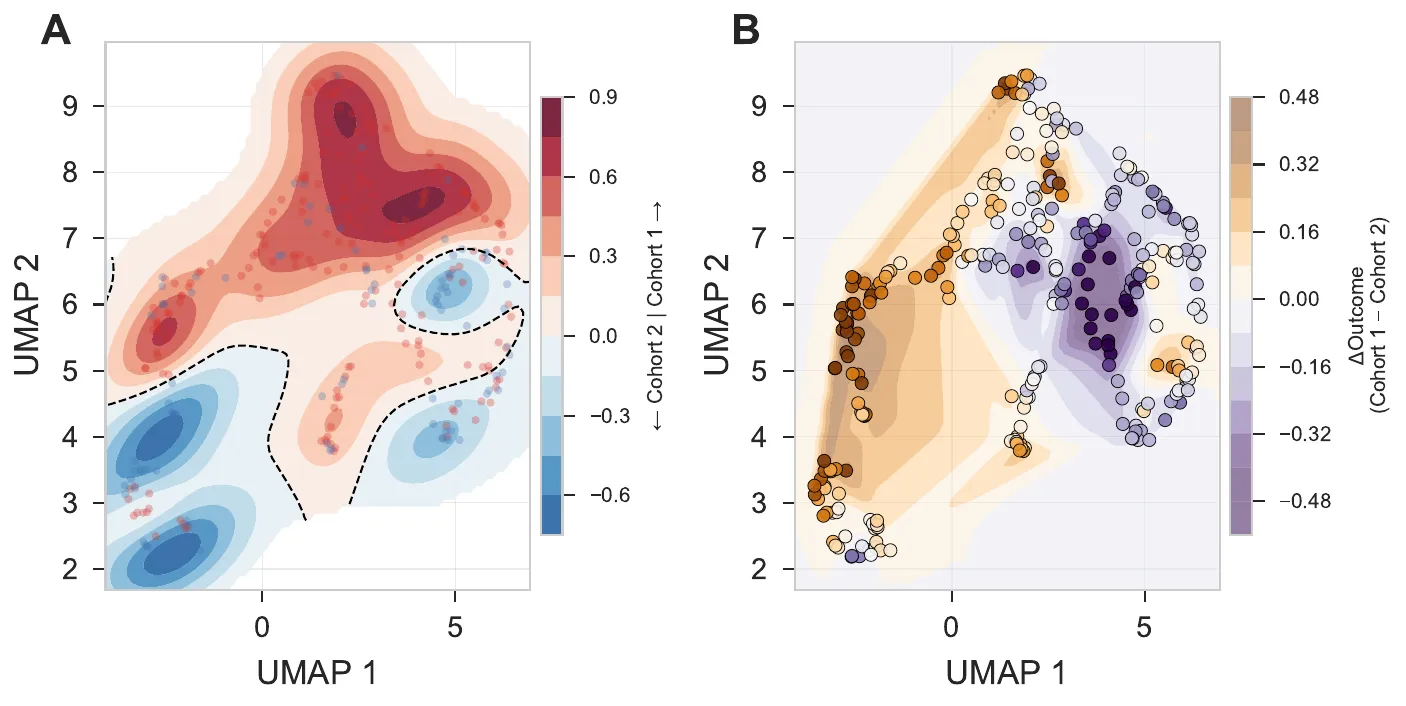
Two maps of the same learned patient space. On the left, the signed difference between the two clinics' fitted coefficient surfaces at matched patient positions, deep red where the first clinic's coefficient runs higher and deep blue where the second's does, with a dashed line marking where they agree. On the right, the same difference carried onto the outcome scale, orange and purple regions showing which patients the two clinics would be predicted differently for.

Finding

Comparable patients. Different hospital. Different answer.

Two clinics treating comparable patients still produced different predictions. To check the finding was real, I shuffled the clinic labels at random — and the contextual signal fell by more than a factor of ten.

How it works

Contrasting Global and Patient-Specific Regression Models via a Neural Network Representation

2026 · Biometrical Journal · DOI

Representation Learning for Distinguishing Case-Mix from Context in Multi-Cohort Prediction

2026 · Under review

Improving prediction models by incorporating external data with weights based on similarity

2024 · arXiv preprint · DOI

Neuromuscular diseaseRadiation oncologyDermatologyOrthopedicsCardiologyImmunologyNewborn screeningUrology
Clinical collaborations20

2026

Challenges and solutions in determining urolithiasis caseloads using the digital infrastructure of a clinical data warehouse

M Schönthaler, N Hempen, M Weymann, …, M Behrens, et al.

PLoS ONE

2025

Treatment evolution in spinal muscular atrophy: insights from the SMArtCARE registry

C Voigt-Müller, M Pfaffenlehner, G Bernert, …, M Behrens, et al.

Brain

Methodological challenges using routine clinical care data for real-world evidence: a rapid review utilizing a systematic literature search and focus group discussion

M Pfaffenlehner, M Behrens, D Zöller, et al.

BMC Medical Research Methodology

2024

Predicting cisplatin tolerability in older adults with head and neck cancer – Insights for improved chemoradiation outcomes

A Rühle, M Weymann, M Behrens, et al.

Radiotherapy and Oncology

Investigating a Domain Adaptation Approach for Integrating Different Measurement Instruments in a Longitudinal Clinical Registry

M Hackenberg, M Pfaffenlehner, M Behrens, A Pechmann, J Kirschner, H Binder

Biometrical Journal

Clinical Effectiveness of Newborn Screening for Spinal Muscular Atrophy

O Schwartz, K Vill, M Pfaffenlehner, …, M Behrens, et al.

JAMA Pediatrics

Development of a Prediction Model for Cisplatin Tolerability during Chemoradiation in Older Adults with Head and Neck Squamous Cell Carcinoma

A Rühle, M Weymann, M Behrens, et al.

International Journal of Radiation Oncology, Biology, Physics

Duration of Dual Antiplatelet Therapy after Percutaneous Coronary Intervention of Unprotected Left Main Coronary Artery Stenosis: 6 versus 12 Months

T Hartikainen, S Mertins, M Behrens, et al.

Journal of Clinical Medicine

Combining propensity score methods with variational autoencoders for generating synthetic data in presence of latent sub-groups

K Farhadyar, F Bonofiglio, M Hackenberg, M Behrens, D Zöller, H Binder

BMC Medical Research Methodology

Medial malleolar osteotomy in the treatment of osteochondral lesions of the Talus – incidence and impact on functional outcome: a retrospective analysis based on data from the German Cartilage Register (KnorpelRegister DGOU)

L Klein, G Bode, M Wenning, M Behrens, H Schmal, J Kühle

BMC Musculoskeletal Disorders

Effectiveness of IT-supported patient recruitment: study protocol for an interrupted time series study at ten German university hospitals

M Boeker, D Zöller, R Blasini, P Macho, S Helfer, M Behrens, H Prokosch, C Gülden

Trials

2023

A Multicenter Evaluation of Different Chemotherapy Regimens in Older Adults With Head and Neck Squamous Cell Carcinoma Undergoing Definitive Chemoradiation

A Rühle, M Weymann, M Behrens, et al.

International Journal of Radiation Oncology, Biology, Physics

Evaluation of Concomitant Systemic Treatment in Older Adults With Head and Neck Squamous Cell Carcinoma Undergoing Definitive Radiotherapy

A Rühle, S Marschner, M Haderlein, …, M Behrens, et al.

JAMA Network Open

Primate liver tissue substrate in indirect immunofluorescence diagnostics for patients with dermatitis herpetiformis and celiac disease

F Schauer, G Tasiopoulou, DP Schuster, M Behrens, S Müller, D Kiritsi

Frontiers in Immunology

2022

Improvements in Walking Distance during Nusinersen Treatment – A Prospective 3-year SMArtCARE Registry Study

A Pechmann, M Behrens, K Dörnbrack, et al.

Journal of Neuromuscular Diseases

Improved upper limb function in non-ambulant children with SMA type 2 and 3 during nusinersen treatment: a prospective 3-years SMArtCARE registry study

A Pechmann, M Behrens, K Dörnbrack, et al.

Orphanet Journal of Rare Diseases

General, spinal or regional anaesthesia does not affect strength performance 6 months after ACL reconstruction

M Wenning, M Mauch, AH Heitner, S Heinrich, G Sofack, M Behrens, R Ritzmann

Knee Surgery, Sports Traumatology, Arthroscopy

Effect of nusinersen on motor, respiratory and bulbar function in early-onset spinal muscular atrophy

A Pechmann, M Behrens, K Dörnbrack, et al.

Brain

Additive Intralesional Interleukin-2 Improves Progression-Free Survival in a Distinct Subgroup of Melanoma Patients with Prior Progression under Immunotherapy

D Rafei-Shamsabadi, S Lehr, M Behrens, F Meiß

Cancers

2021

Impact of the COVID-19 pandemic on hospitalizations of patients with moderate-to-severe skin diseases: A retrospective cohort analysis from a Central European Center

F Schauer, M Behrens, S Mueller, F Meiß, D Kiritsi

Journal of the American Academy of Dermatology

2021–present
Biostatistics & Study DesignHochschule MannheimSix-week course
2020–present
Statistics for Medical Students (Querschnittsbereich 1)University of Freiburg
2026
Working effectively with AI agentsISCB–GMDS ConferenceHalf-day course, with Fabian Kabus
2026
Session Chair, SimilaritySmallData Symposium, CRC 1597 “Small Data”Freiburg, October 2026

I am a research associate (Wissenschaftlicher Mitarbeiter) at the Institute of Medical Biometry and Statistics in Freiburg, finishing a doctorate on when and how data from one clinical setting can inform prediction in another.

Before that I worked in data science at Hermes and KPMG in Hamburg. Most of my work is about the part that comes after a model: whether the result holds up, and how you would know.

Positions

2020–present
Research Associate (Wissenschaftlicher Mitarbeiter)Institute of Medical Biometry and Statistics, University of Freiburg
2019–2020
Associate Data ScientistKPMG GermanyHamburg
2018–2019
Working Student, Data AnalyticsKPMG GermanyHamburg
2018
Working Student, Data ScienceHermesHamburg
2017–2018
Intern, Data ScienceHermesHamburg

Education

2018–2020
MSc Data AnalyticsUniversity of GlasgowOnline distance learning, School of Mathematics and Statistics
2014–2018
BSc PsychologyUniversity of MannheimMinor in Computer Science